Overview
A unified digital platform for consulting, staffing, and candidate discovery.
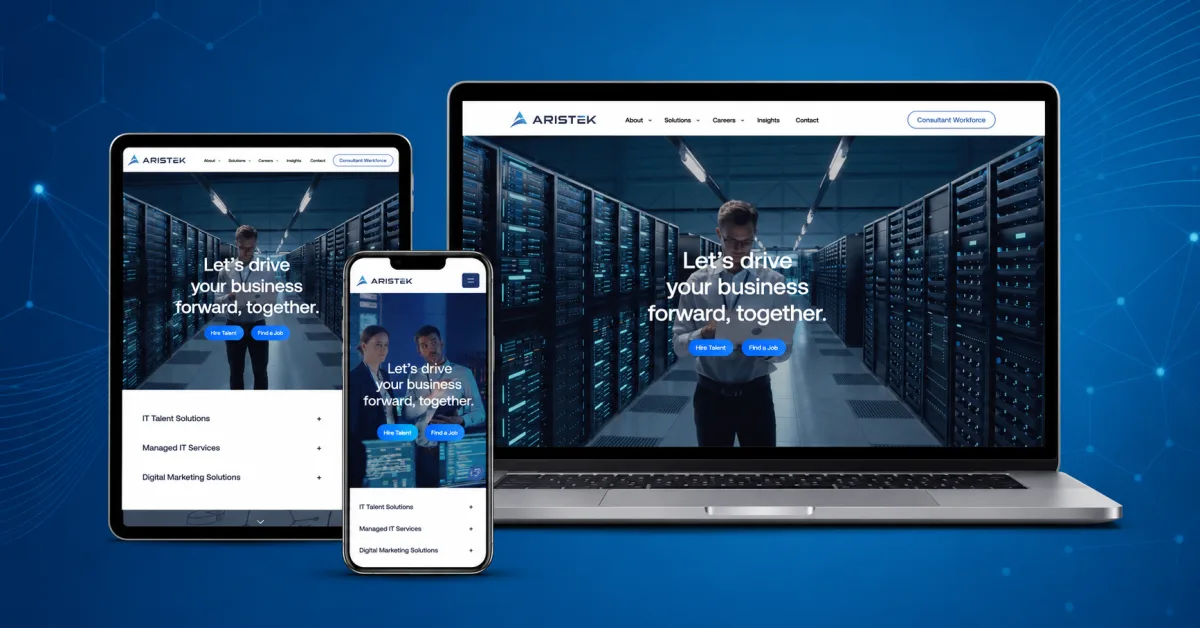
Aristek Consulting is a national technology consulting firm serving IT Talent Solutions, Managed IT Services, and digital growth for staffing companies across the United States.
The company needed a modern website that could represent its services professionally while supporting recruiting operations through a fully integrated job portal. CEIPAL already powered job management, candidate tracking, recruiting workflows, and external publishing; the new website needed to preserve those operations while delivering a lightweight, scalable, and fully branded experience.
IT Talent Solutions
- Contract staffing
- Contract-to-hire staffing
- Direct-hire recruiting
- Technology-focused talent acquisition
Managed IT Services
- Infrastructure support
- Managed technical operations
- Ongoing business technology support
- Scalable outsourced IT solutions
Digital Growth
- Website design and branding
- SEO strategy
- Sales-enablement systems
- Staffing-focused digital experiences
Aristek’s more than two decades of hands-on IT and staffing experience made industry credibility essential. The platform needed to communicate technical capability and direct operational understanding to clients, candidates, and partners.
The delivery objectives were connected: create a fully custom WordPress website, keep the architecture lightweight, avoid dependency-heavy visual builders, give the content team reusable Gutenberg systems, integrate CEIPAL through an API, and present candidates with a seamless branded job-search experience. The foundation also needed to remain maintainable as the company’s services, recruiting operations, and content programme expanded.
The challenge
CEIPAL powered recruiting operations, but its iframe weakened the candidate experience.
CEIPAL handled job postings, resumes, candidate tracking, recruiting workflows, hiring coordination, and multi-platform distribution. Its standard website option was an embedded iframe: functional, but visibly separate from the rest of the Aristek experience.
Design inconsistency
Typography, spacing, layout rhythm, navigation, and responsive behaviour changed as visitors moved into the job portal. The recruiting experience felt like an external tool instead of a natural extension of the brand, reducing the sense of polish and trust expected from a modern consulting and staffing firm.
Limited flexibility
The embedded interface restricted job filtering, search, layout structure, mobile behaviour, SEO, front-end interactions, and future evolution. Aristek could not fully own the candidate journey.
Performance concerns
The client explicitly wanted to avoid heavy visual builders, excessive plugins, bloated front-end assets, and difficult long-term maintenance.
Multiple audiences
The site had to serve staffing clients, candidates, technology-consulting prospects, managed-service inquiries, and long-term recruiting operations without becoming confusing or overly corporate.
My responsibility
I led the complete delivery—from the client’s concept to the launched platform.
As senior developer and project lead, I translated the client’s objectives into the site structure and technical plan, collaborated closely with the designer, guided implementation decisions, and developed the WordPress platform and CEIPAL integration.
My role connected client discovery, user-experience decisions, design collaboration, technical architecture, custom Gutenberg development, React interfaces, API integration, performance planning, and final implementation. That end-to-end ownership kept the visual and operational systems aligned instead of treating the website and job portal as separate projects.
Strategy & design
The experience strategy balanced brand positioning with operational recruiting.
Planning began with staffing workflows, candidate expectations, recruiter needs, user journeys, content scalability, performance requirements, and ease of internal management. Those inputs shaped both the information architecture and technical system.
The planning process balanced brand positioning with the reality of recruiting operations. Candidates often compare many roles in a short period, recruiters need CEIPAL to remain the operational source of truth, and the internal team needs to publish marketing content without rebuilding layouts. Each audience had to receive a clearer experience without adding complexity for another.
Custom Figma design system
The visual system was tailored to staffing and technology consulting rather than adapted from a generic template. It focused on hierarchy, service clarity, calls to action, readability, modern structure, mobile responsiveness, trust, and credibility.
Candidate browsing
Job seekers needed a fast, clear, mobile-friendly, and trustworthy path to understand available roles, the company’s specialization, listing navigation, and the natural application journey.
Service discovery
The structure gradually explains what Aristek does, who each service supports, how the company differentiates itself, and which service is relevant to each visitor.
Trust through presentation
Typography, spacing, section separation, navigation clarity, and restrained visual patterns were designed to communicate organization, reliability, technical capability, professionalism, and industry experience.
The final positioning needed to feel credible to enterprise clients and job seekers at the same time: modern enough for a technology consultancy, but authentic to a staffing organization with real operational understanding.
Readability remained central because staffing and IT consulting sites carry large amounts of service, role, and operational information. Typography hierarchy, spacing, section separation, responsive layouts, and scanning behaviour were treated as functional decisions rather than decoration. The navigation supports visitors exploring services, seeking staffing solutions, browsing jobs, learning about the company, or contacting the team without making any one audience feel secondary.
WordPress architecture
Native Gutenberg where content needed control; React where interaction needed speed.
The website was built around native WordPress and custom Gutenberg systems instead of a dependency-heavy page builder. This reduced front-end weight, produced cleaner output, improved maintainability, and gave the content team reusable tools designed around the brand.
Why Gutenberg-first
- Cleaner front-end output
- Fewer external dependencies
- Better loading performance
- Higher long-term maintainability
- Reusable content systems
- Future scalability
Why heavy builders were avoided
- Excessive CSS and JavaScript
- Large DOM structures
- Plugin conflicts
- Difficult scalability
- Reduced maintainability
The resulting architecture combines WordPress Gutenberg, custom blocks, custom plugin development, React-powered interfaces where necessary, and component-based front-end systems.
This split keeps server-rendered marketing and editorial content fast and accessible while reserving JavaScript for experiences that materially benefit from live updates. It also avoids the large DOM structures, repeated assets, plugin conflicts, and editor complexity commonly introduced by general-purpose visual builders.
Reusable publishing system
Purpose-built blocks protect consistency while keeping the site flexible.
The custom block system was designed to solve operational and scalability needs, not simply provide visual flexibility. Editors can create and rearrange pages, reuse layouts, and grow the site without breaking the design language or depending on developers for routine updates.
Service section blocks
Reusable layouts support service overviews, supporting detail, industry messaging, process explanations, feature highlights, and calls to action across staffing, managed IT, and digital-growth pages.
Staffing-focused blocks
Candidate messaging, hiring processes, recruiting-service positioning, employer content, industry trust sections, and technology-staffing presentation use structures designed for the actual business.
CTA systems
Editors can combine headlines, descriptions, action buttons, backgrounds, layouts, and alignment options without introducing the weight of a third-party visual builder.
Blog and content grids
Custom listing blocks and React-powered rendering support flexible content layouts, responsive behaviour, and a consistent visual connection between editorial and marketing pages.
Reusable layouts
The team can rearrange sections, create landing pages faster, preserve branding, expand the site, and reduce developer dependency for smaller content changes.
Editor optimization
Unnecessary controls were removed, editing workflows were kept clean, and visual consistency is enforced automatically for non-technical staff.
Because every block was built for the project, the platform avoids generic builder overhead. Reduced asset loading, cleaner HTML, less unnecessary JavaScript, more efficient rendering, and a maintainable front-end architecture support the original performance goals.
The editor experience received the same attention as the public website. Purpose-specific controls remove irrelevant choices, sensible defaults protect spacing and typography, and flexible content fields let non-technical editors change the message without accidentally changing the design system. This makes routine publishing faster while reducing the long-term cost of corrections.
CEIPAL job portal
A custom API integration replaced the disconnected iframe.
A purpose-built WordPress plugin communicates directly with CEIPAL, retrieves current job data, and lets the website control the complete candidate-facing experience.
Custom job listings
Typography, spacing, branding, navigation, layouts, and responsive behaviour now match the rest of the website. Candidates no longer move into a visibly disconnected external interface.
Search and filtering
The architecture supports keyword search, department, job category, employment type, location, and remote or hybrid filters—far beyond the flexibility of the default iframe.
CEIPAL synchronization
Jobs remain centrally managed in CEIPAL and flow to the website through the API. This reduces administrative duplication and preserves recruiter workflows while giving the front end complete presentation control.
Multi-platform publishing
Aristek retains CEIPAL’s ability to distribute opportunities to LinkedIn, Indeed, Glassdoor, and other recruiting platforms while also presenting a fully branded experience on its own website.
React is used selectively for listing, filtering, and other interactive interfaces. This provides fast updates and future flexibility without turning the entire marketing site into a JavaScript-heavy application.
CEIPAL remains the centralized system for job management, resumes, candidate tracking, hiring coordination, and distribution. The API layer removes duplicated entry: recruiters continue their established workflow, updates synchronize with the website, and the presentation layer can evolve independently. Jobs can still be distributed to LinkedIn, Indeed, Glassdoor, and other platforms while Aristek’s own site provides the strongest branded experience.
Performance & impact
The platform improved presentation without disrupting recruiting operations.
Stronger brand positioning
Aristek now presents itself as a modern technology consulting and staffing company with a polished, credible, and consistent digital presence.
Better candidate experience
Job seekers browse opportunities in a cleaner, responsive environment aligned with the company’s branding and navigation.
Operational efficiency
Recruiters continue using CEIPAL for existing workflows. The website improves presentation and interaction without forcing the team to replace its operational system.
Long-term scalability
Reusable Gutenberg blocks, selective React interfaces, and purpose-built plugins let the platform evolve without page-builder lock-in or a complete redesign.
Performance decisions remained consistent throughout development: minimal plugin dependency, efficient asset loading, component-based architecture, Gutenberg-first rendering, structured React implementation, and clean front-end output.
Technology
A lightweight WordPress foundation with focused interactive layers.
- WordPress
- Gutenberg
- Custom blocks
- PHP
- Custom plugins
- WordPress APIs
- React
- JavaScript
- HTML5
- CSS3
- CEIPAL API
- Figma
Final result
A lighter foundation with complete control over the recruiting experience.
The final solution delivered a fully custom WordPress website, a lightweight Gutenberg architecture, reusable blocks, React-powered dynamic interfaces, and a completely integrated CEIPAL job portal.
Aristek maintains the operational power of CEIPAL while candidates receive a modern, branded, and scalable experience directly on the company’s website. The new platform improves consistency, candidate experience, maintainability, future scalability, plugin independence, and long-term performance.